Contributing Author & Editorial Review
This article was crafted and reviewed by experienced professionals to ensure accuracy and practical insight.


DSCR Rental Loan Highlights
- Qualification based mainly on property cash flow (DSCR).
- No personal income docs required for many programs.
- Financing for 1–8 unit rentals, portfolios, and many STR/Airbnb deals.
- Up to 80% LTV on purchases and 75% LTV on cash-out (program-dependent).
- 30-year fixed and interest-only options available.
Fix-and-Flip Strategies for Small Investors in Minneapolis – 2025 Guide
Minneapolis’ residential real estate market offers significant opportunities for small-scale investors, especially those focused on fix-and-flip strategies in 2025. With median home prices stabilizing around 5,000 and a dynamic, growing demand for updated single-family homes and small multifamily units, the Minneapolis fix-and-flip scene is more accessible than ever. This in-depth guide covers everything local investors need to know to find success with fix-and-flips in Minneapolis’s 2025 market—market analysis, step-by-step implementation, local trends, regulations, financing, and real success stories. Whether you’re new to residential investing or looking to scale your portfolio, Minneapolis provides diverse property types, strong job market fundamentals, and streamlined small investor resources. Harness proven strategies and seize fix-and-flip property investment opportunities in Minneapolis for reliable ROI and sustainable portfolio growth.
- Fix-and-Flip Strategies for Small Investors in Minneapolis – 2025 Guide
- Fix-and-Flip Investing Overview in Minneapolis Residential Market
- Local Minneapolis Market Analysis and Investment Opportunities
- Fix-and-Flip Strategies and Implementation Guide
- Minneapolis-Specific Success Stories and Case Studies
- Financing Options and Local Lender Programs
- Legal Considerations and Local Regulations
- Common Challenges and Solutions
- Building Your Local Network and Resources
- Step-by-Step Action Plan for Getting Started
- Frequently Asked Questions
- Conclusion and Next Steps for Minneapolis Small Investors
Fix-and-Flip Investing Overview in Minneapolis Residential Market
- Minneapolis is witnessing sustained job growth in healthcare, tech, education, and manufacturing sectors, fueling demand for updated, move-in-ready homes.
- The 2025 median sale price for a single-family home is approximately $345,000, with most fix-and-flip candidates found between $185,000 and $270,000, especially in neighborhoods like Powderhorn, Phillips West, and Northeast Minneapolis.
- Average fix-and-flip ROI in Minneapolis is 17%–23%, with ARVs (After Repair Values) surging due to buyer preference for renovated properties.
- Small investors in Minneapolis are gaining ground by leveraging flexible financing, local contractor relationships, and city-specific market data in their residential investing strategies.
Local Minneapolis Market Analysis and Investment Opportunities
In Minneapolis, fix-and-flip real estate opportunities show median property prices of 5,000–0,000 for distressed homes, with average resale values post-renovation of 5,000–5,000. Local rent yields average 6.3%, providing fallback options for unsuccessful flips.
Best Neighborhoods for Fix-and-Flip:
Need capital? GHC Funding offers flexible funding solutions to support your business growth or real estate projects. Discover fast, reliable financing options today!
⚡ Key Flexible Funding Options:
GHC Funding everages financing types that prioritize asset value and cash flow over lengthy financial history checks:
DSCR Rental Loan
- No tax returns required
- Qualify using rental income (DSCR-based)
- Fast closings ~3–4 weeks
SBA 7(a) Loan
- Lower down payments vs banks
- Long amortization improves cash flow
- Good if your business occupies 51%+
Bridge Loan
- Close quickly — move on opportunities
- Flexible underwriting
- Great for value-add or transitional assets
SBA 504 Loan
- Low fixed rates through CDC portion
- Great for construction, expansion, fixed assets
- Often lower down payment than bank loans
🌐 Learn More
For details on GHC Funding's specific products and to start an application, please visit our homepage:
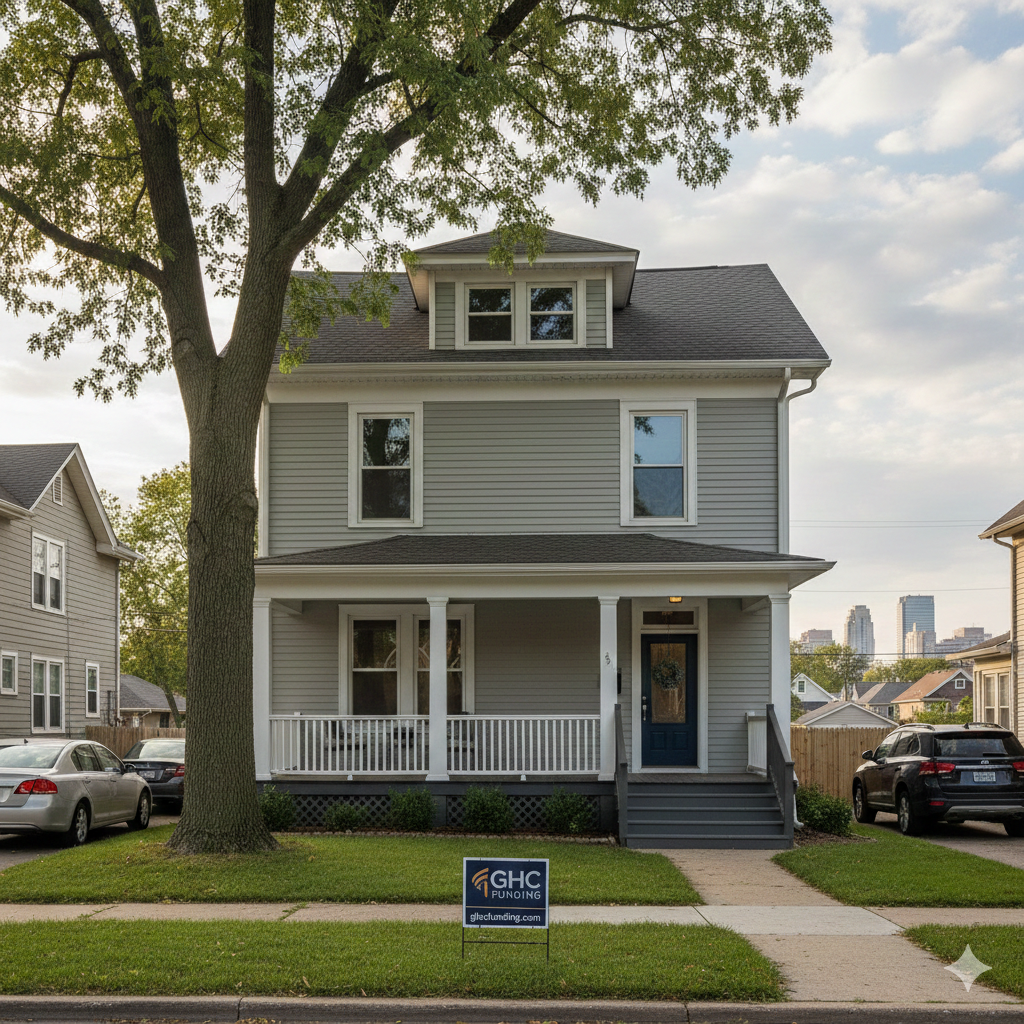
- Powderhorn: Affordable older homes, strong first-time homebuyer demand, fixers from $175,000.
- Longfellow: Consistent appreciation, starter homes needing updates, ARVs up to $420,000.
- Northeast Minneapolis: Increasing revitalization, loft conversions & duplexes ripe for flipping.
- Bryn Mawr & Fulton: Higher-end flips yielding fast resale.
Local data shows over 294 distressed properties listed in Q1 2025, many ideal for cosmetic upgrades or full-gut renovations.
Fix-and-Flip Strategies and Implementation Guide
1. Finding Distressed Properties
- Monitor Hennepin County foreclosure auctions and Minneapolis tax lien sales for entry-level opportunities.
- Network with local wholesalers through groups like Minnesota Real Estate Investors Association (MNREIA).
- Deploy targeted direct mail campaigns in neighborhoods aging 50+ years.
2. Accurately Estimating Renovation Costs
- Minneapolis contractors currently charge $40–$90 per sq ft for standard rehabs; consult with two or more professionals for bids.
- Use tools such as FlipperForce or PropertyFixer for budgeting and ARV calculations.
3. Managing Projects and Timelines
- A typical fix-and-flip in Minneapolis takes 3–5 months from acquisition to resale.
- Negotiate draw schedules and payment milestones with local licensed contractors to ensure accountability.
4. Financing Fix-and-Flip Projects Locally
- Try hard money lenders like Northstar Funding (Minnetonka) or credit unions like Affinity Plus Federal Credit Union.
- Leverage Minneapolis’ Community Land Trust for down payment assistance when applicable.
5. Exit Strategies
- List for sale in peak spring/summer selling seasons; Minneapolis homes average 14 days on market post-renovation.
- If required, rent out completed properties for cash flow (average Minneapolis rent for a 3BR: $2,200/month).
Minneapolis-Specific Success Stories and Case Studies
Local Minneapolis investor Sarah B., a first-time flipper, acquired a distressed duplex in Longfellow for $225,000, invested $45,000 in renovations (kitchen, bath, windows), and resold the property for $340,000 in under 5 months—a net profit of $49,000. Her approach included working with a Midtown contractor referral network and financing via Affinity Plus’ short-term investor loan product.
Another investor, Mark S., utilized a subject-to deal in Powderhorn, taking over a pre-foreclosure home for $192,000, spending $30,000 in modern updates. He achieved a rapid ARV of 7,000 and generated ,000 profit after costs—all within 2024–2025’s evolving Minneapolis real estate market.
Financing Options and Local Lender Programs
- Affinity Plus Federal Credit Union: Offers investor rehab loans with lower origination fees for local buyers.
- Northstar Funding: Experienced in hard money fix-and-flip financing, 12%–13% interest rates.
- Sunrise Banks: Provides portfolio lines of credit and construction loans for qualified small investors.
- LendLocal Minneapolis: Down payment assistance up to $40,000 for first-time buyers, applicable to major rehabs in select neighborhoods.
Legal Considerations and Local Regulations
- Minneapolis rental licensing: Any rental conversion after a failed flip must be licensed with City of Minneapolis, including safety inspections.
- Permitting requirements: Renovations, electrical, and plumbing over $2,000 require city permits and inspections; obtain before work starts.
- Anti-blight enforcement: Properties held vacant more than 365 days are subject to increased city vacancy fees.
- Lead paint disclosure: Required for homes built before 1978.
- Contractor licensing: Ensure all hired professionals are licensed by the State of Minnesota.
Common Challenges and Solutions
- Competition from institutional buyers: Offset by targeting off-market or overlooked properties with local connections.
- Permit delays: Work with experienced local architects to streamline submission.
- Cost overruns: Use detailed scopes of work (SOW) and fixed-price contracts.
- Resale timing: Plan for seasonal market swings; spring sells 22% faster than winter in Minneapolis.
- Neighborhood transformation risk: Focus on areas with confirmed development plans or city investments.
Building Your Local Network and Resources
- Join MNREIA and attend monthly meetups for contractor and deal referrals.
- Utilize the Minneapolis Fix-and-Flip group on Meetup.com for investment partnerships.
- Connect with local real estate attorneys, CPAs, and title companies familiar with small residential transactions.
- Engage with City of Minneapolis housing staff for guidance on code compliance and funding programs.
Step-by-Step Action Plan for Getting Started
- Join a local meetup or REI club to start networking immediately.
- Identify 3–5 potential Minneapolis neighborhoods with high upside potential; review MLS and auction data weekly.
- Build relationships with 2–3 local lenders or credit unions offering fix-and-flip financing.
- Attend free city housing department workshops to stay up to date on permits/regulations.
- Tour 10+ properties in target neighborhoods and analyze repair scopes and ARVs using contractor input.
- Structure offers to include inspection contingencies and 10–15% repair budget buffer.
- Set up project management tools and line up trusted contractors before closing your first deal.
Frequently Asked Questions
- 1. What’s the best area in Minneapolis for new fix-and-flip investors?
- Northeast Minneapolis and Longfellow offer approachable purchase prices and strong resale demand, ideal for first-time flippers.
- 2. How much capital do I need to start a fix-and-flip in Minneapolis?
- Typically, $55,000–$90,000 covers a 20% down payment, soft costs, and upfront rehab, but local financing programs can lower this threshold.
- 3. What are common permitting pitfalls for Minneapolis flippers?
- Overlooking electrical and plumbing permits—work with local contractors familiar with city processes to avoid costly delays and fines.
- 4. Can fix-and-flip properties be rented out if unable to sell?
- Yes, many Minneapolis investors successfully transition flips to rentals, but a city rental license and safety inspection are required first.
- 5. Are there unique Minneapolis tax incentives for residential fix-and-flip investors?
- Historic tax credits may apply for qualifying renovations; consult with a local CPA for potential state or city-specific credits and 1031 exchange options.
- 6. How do local Minneapolis lenders support small-scale investors?
- Credit unions and hard money lenders commonly offer fix-and-flip friendly terms, flexible underwriting, and rehab draws for small investors.
Get a Free Rate Today
Compare our top-rated commercial and investment property loan programs below.
- No income verification
- 30-year fixed | Interest-only available
- Great for rental properties + STR
- Fast approvals
- Working capital + business acquisition
- Up to $5M
- Low down payment
- Long-term financing
- Owner-occupied CRE
- Low fixed rates | 25-year terms
- Great for business expansion
- Refinance available
- Best for stabilized properties
- Competitive rates
- 12–25 year terms
- Lower fees than private lenders
Compare Loan Types
Find the Right Financing for Your Real Estate or Business Project
| Loan Type | Best For | Rates | Terms | Highlights | Apply |
|---|---|---|---|---|---|
| DSCR Loan | Rental properties (LTR & STR) | 5.99%+ | 30-year fixed, IO options | No income docs, fast approvals, great for investors | Check My Rate |
| Construction Loan | Ground-up, fix & build, major renovations | 8%–12% depending on scope | 12–24 months interest-only | Flexible draws, great for builders & developers | Get a Quote |
| SBA Loan | Business acquisition, working capital, CRE | Prime + spread | 10–25 years | Lowest down payments, long terms, best for business growth | See My Options |

SBA Loan Requirements for Startups in Florida Now
GHC Funding Website Published: March 9, 2026 Categories: blog Reading Time: 3 minutes read Understanding SBA Loan Requirements for Startups in Florida:…
Read more →
“Prompt Engineering” Myth: How to Actually Talk to AI
GHC Funding Website Published: March 6, 2026 Categories: blog Reading Time: 4 minutes read 🗣️ The “Prompt Engineering” Myth: How to Actually…
Read more →
No-B.S. AI Guide to Work Less and Grow More in 2026 Now
GHC Funding Website Published: March 6, 2026 Categories: blog Reading Time: 5 minutes read 🚀 The No-B.S. Guide to AI for Small…
Read more →
No Doc DSCR Loans for Property in Florida Now
GHC Funding Website Published: March 5, 2026 Updated: March 6, 2026 Categories: blog Reading Time: 3 minutes read Unlocking Investment Potential: No…
Read more →
Construction Loan Lenders and Process in Florida Now
GHC Funding Website Published: March 5, 2026 Categories: blog Reading Time: 3 minutes read Unlocking Opportunities: Navigating Construction Loan Lenders in Florida…
Read more →
Get The SBA Express Loan Application in Florida Now
GHC Funding Website Published: March 5, 2026 Categories: blog Reading Time: 3 minutes read Simplifying the SBA Express Loan Application Process in…
Read more →Conclusion and Next Steps for Minneapolis Small Investors
Small-scale fix-and-flip investing in Minneapolis remains one of the city’s most powerful wealth-building strategies in 2025 if approached with market-specific knowledge and community engagement. The Minneapolis market rewards careful property selection, due diligence on repairs and legalities, and strong local networks. Start by connecting with established investor groups, locking in reliable financing channels, and scouting undervalued homes in high-demand neighborhoods. Use the step-by-step plan provided to confidently launch or grow your Minneapolis fix-and-flip business—capitalize on 2025’s robust market and empower your small portfolio to thrive.
Get a No Obligation Quote Today.

Use these trusted resources to grow and manage your small business—then connect with GHC Funding
to explore financing options tailored to your needs.
GHC Funding helps entrepreneurs secure working capital, equipment financing, real estate loans,
and more—start your funding conversation today.
Helpful Small Business Resources